The destructive relationship cycle and the savior complex
After Ever HappyThe destructive relationship cycle and the savior complex take shape in the mismatch between Hardin Scott’s repeated withdrawal and Tessa’s repeated efforts to reach him. Hardin presents distance as a way to protect her from the damage he believes he causes; Tessa increasingly sees that explanation as bound up with his self-destructive habits, while her own loyalty keeps drawing her back into the work of saving him. The relationship’s turning point comes when she stops treating endurance as proof of love and begins to recognize the cost of the cycle to herself.
The cycle of withdrawal and pursuit
Hardin tells Tessa that he wants time apart because she is facing problems she would never have encountered without him. His explanation gives the separation a protective shape: if he sends her away, she might see what he is doing to her. Yet Tessa hears a different motive beneath that account. She objects that he is acting out of self-destruction, not simply for her benefit. Their disagreement exposes the cycle’s central tension: Hardin describes withdrawal as an attempt to spare Tessa, while Tessa experiences it as another instance of being pushed away when he is hurt.
The pattern has consequences beyond the couple’s immediate arguments. In her account to Kimberly, Tessa describes Hardin staying in London and wanting to send her back to Seattle, his withdrawal after being hurt, and his burning of the house. She says that he shows no remorse and that his anger is making matters worse for him. The separation is therefore not an isolated disagreement about where they should live. It arrives amid family upheaval and destructive behavior, and Tessa understands those circumstances as reasons Hardin needs to face his pain rather than retreat from her.
Tessa’s role as rescuer
Tessa tells Kimberly that Hardin pushes her away whenever he is hurt, even though he says he cannot live without her. She believes he could get through the crisis if he acknowledged his anger and admitted that other people matter to him. Her wish to help is persistent, but the account also shows its exhaustion: she can imagine leaving only with such pain that she nearly collapses. After months of turmoil, she says she would still rather endure the relationship than be without him, and she wants Hardin to be happy even when that happiness is not for her.
That devotion does not feel uncomplicated to Tessa. While confiding in Kimberly, she gestures around the room and describes how she remains in the relationship despite the battles. She has to stop to drink half a cup of coffee; her voice is strained from talking through a sore throat. These details make the confession physical as well as emotional: the effort of explaining and defending the relationship has worn her down. She wonders whether her attachment is delusion or madness, but her own account keeps returning to the same conflict between wanting to save Hardin and feeling tired of fighting for him.
Hardin’s protective rationale
Hardin’s private reasoning turns the prospect of a shared future into an argument for leaving. He imagines a life with Tessa in their forties without marriage or children and recognizes that such a future could suit him, but not satisfy her. He expects that she would surrender those hopes for his sake. Calling himself unfit to be a father, he interprets the trip as a wake-up call: in his view, sending her back to America gives her an easy way out and prevents years of loneliness and resentment.
His reasoning also contains an admission of his own part in the imbalance. He recognizes that he has not tried hard enough to keep Tessa safe from him, but admits that he could not bring himself to push her away because doing so would cost him what he wanted from her. He sees her as someone who gives without taking and himself as someone who takes until nothing remains. The language of protection therefore sits beside a stark acknowledgment of selfishness: the person claiming to release Tessa also knows he has benefited from her willingness to stay.
Hardin further questions whether Tessa’s devotion is love or an addiction to the cycle itself. He imagines that she may see him as a project to fix, and that each new failure gives her another opportunity to be there for him. This is his suspicion, not an established account of Tessa’s motives; his own analysis is shaped by distrust and self-condemnation. Still, it reveals how completely the relationship has become organized around injury and repair. He fears that her care is sustained by his need to be rescued, while Tessa’s earlier confession shows how difficult it is for her to separate loving him from continuing to fight for him.
The break in Tessa’s interpretation
After seeing Hardin impaired and another woman wearing his shirt, Tessa reaches a conclusion that changes how she understands her previous loyalty. She recognizes that she has made excuses for his behavior, including when his pain over the betrayal involving his mother and Christian Vance helps explain his distress. But she no longer accepts that pain as permission to hurt her. She also acknowledges that she has tried to support him while tolerating his displaced anger for too long. The distinction is crucial: understanding why Hardin is suffering no longer obliges her to absorb the consequences of his actions.
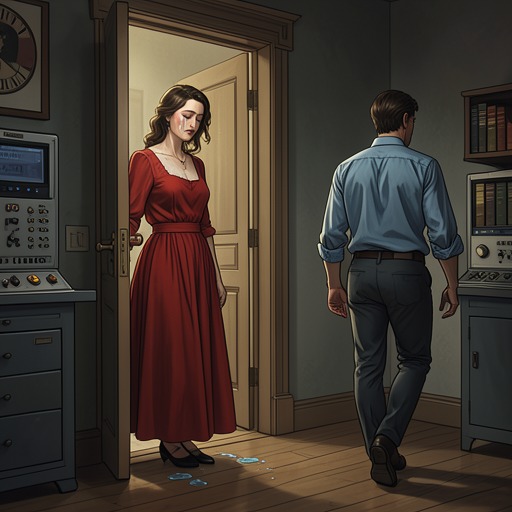
The confrontation makes that shift visible in action. Tessa offers Hardin one last chance to leave with her and return home; when he remains silent, she tells him that he can continue drinking and smoking but will be left with the life he has chosen. She has seen this kind of scene too many times and tells him that this will be the last. Even as she challenges him, the old cycle remains present: she is still offering departure together, still trying to make him choose a different course. What changes is her willingness to treat another apology or promise as enough to erase the pattern.
When Hardin says she does not belong there and tells her to go back where she belongs, Tessa answers that he has won again. The exchange ends not with evidence of reconciliation, but with her recognition that repeated chances have not made the relationship safe. Her movement is from rescue as an expression of love toward the possibility that love must also include refusing to be destroyed alongside the person one loves.
Significance and limits
The concept is built from two accounts that overlap but do not agree. Hardin sees himself as dangerous to Tessa and frames distance as a sacrifice that could free her; Tessa sees a self-destructive man who withdraws instead of facing pain, and initially believes that her love and persistence can help him change. His fear that she is trying to fix him and her conviction that he could recover if he confronted his anger both make repair central to their bond, but neither belief prevents repeated harm.
The supplied scenes establish a decisive change in Tessa’s understanding, not a final resolution of the relationship. Her ultimatum and refusal to excuse Hardin mark a break with the logic that she must keep enduring in order to save him. The tension remains that she still loves him and has repeatedly found separation painful. The cycle’s force lies precisely in that contradiction: devotion keeps pulling Tessa toward rescue, while her recognition of its cost makes self-preservation newly necessary.